
 See My Latest Article on HelloNation
Stone countertop edge profiles affect more than appearance. They influence how a countertop feels to the touch, how easily it can be cleaned, how noticeable small chips may be, and how well the surface fits the style of a kitchen or bathroom. In Kernersville, NC, homeowners commonly compare edge profiles during remodeling, new-home construction, and replacement projects.
An edge profile is the shaped finish along the exposed perimeter of a stone slab. Fabricators can create simple, squared edges or more decorative contours by shaping and polishing the material. The right choice depends on the room, the stone type, the amount of use, and the level of visual detail desired.
Which countertop edge profiles are most popular?
The most frequently selected profiles are eased, pencil, bevel, bullnose, and ogee. These options cover a wide range of styles, from clean and modern to traditional and decorative. Waterfall edges, which carry the stone down the side of an island or cabinet run, are also a common choice for contemporary kitchens.
Eased edge
An eased edge has a mostly straight profile with a small amount of softening along the top corner. It may look squared from a distance, but the sharp corner is slightly reduced.
This is one of the most practical choices for busy kitchens because it has a simple shape and few grooves where dust or food particles can collect. Its restrained appearance works well with quartz, granite, marble, and other common countertop materials.
An eased profile is often suitable for:
- Contemporary kitchens
- Simple bathroom vanities
- Countertops with prominent veining
- Spaces where the slab pattern should remain the main visual feature
The exact amount of easing varies. A lightly eased edge looks nearly square, while a more softened version feels gentler against the hand.
Pencil edge
A pencil edge has a rounded transition that resembles the curve of a pencil. The corner is softened more noticeably than with a standard eased edge, but the overall profile remains understated.
This profile is popular because it combines a clean appearance with a comfortable feel. The rounded corner can be useful around narrow walkways or work areas where people regularly pass close to the countertop.
Pencil edges are especially common on:
- Kitchen islands
- Peninsula countertops
- Bathroom surfaces
- Family kitchens with frequent daily use
The profile does not usually dominate the design, making it a flexible choice for both traditional and updated interiors.
Beveled edge
A bevel is a straight, angled cut along the top edge of the countertop. The size of the bevel can vary, from a small chamfer to a more noticeable diagonal surface.
Beveled edges create a defined line that catches light and can make the slab appear more structured. They are often selected for modern, transitional, or geometric designs.
A bevel may also make the edge easier to recognize visually, which can be helpful in a busy kitchen. However, the angled section may show dust or crumbs more readily than a very simple rounded profile, particularly on darker surfaces.
Waterfall edge
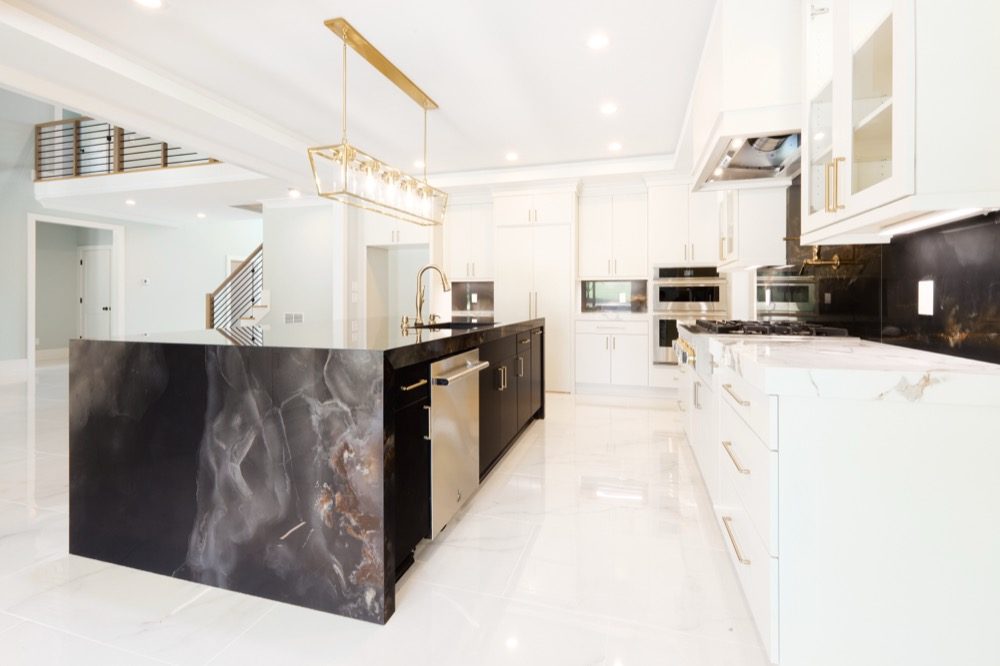
A waterfall edge continues the countertop surface vertically down the side of an island or cabinet run, usually all the way to the floor. Instead of ending at the top edge, the stone turns a 90-degree corner and becomes a side panel.
The corner is typically joined with a mitered seam, in which both pieces are cut at matching angles so the joint appears as one continuous piece of stone. When the slab has veining, fabricators can often align the pattern so it flows across the corner and down the side.
A waterfall edge is often suitable for:
- Kitchen islands that serve as a focal point
- Contemporary and transitional designs
- Quartz, quartzite, marble, and porcelain slabs with prominent veining
- Spaces where the side of the cabinetry would otherwise be exposed
This design uses more material than a standard edge because the side panels come from the same slab. It also requires precise measurement and fabrication so the miter joint stays tight and the panel sits correctly against the floor. The top corner of a waterfall is usually finished with a lightly eased edge, since a sharp mitered corner is more vulnerable to chipping. The vertical panel can also help protect the side of the cabinetry from scuffs caused by stools, feet, and foot traffic.
Are rounded profiles safer for busy kitchens?
Rounded edges can reduce the severity of contact with a sharp countertop corner, especially in homes with children, pets, or narrow passageways. They do not make a countertop risk-free, but they can provide a softer transition than a sharp square edge.
A bullnose is rounded across the top edge and may continue down the side, depending on the design. A half-bullnose rounds the upper portion while leaving the lower side more defined. These profiles create a smooth, finished appearance and are comfortable to touch.
Rounded profiles may be useful for:
- Island corners near walking paths
- Countertops beside seating areas
- Homes with active family kitchens
- Bathroom vanities with limited clearance
A fully rounded edge can make a slab appear visually softer. It may also reduce the prominence of the stone’s thickness, while a more squared edge tends to emphasize a substantial, architectural appearance.
What is an ogee edge, and where does it fit?
An ogee edge is a decorative profile with an S-shaped curve. It is most often associated with traditional, formal, or highly detailed kitchen designs.
Ogee profiles can add visual depth to granite and marble countertops, particularly when the slab has a polished finish. Because the shape includes curves and transitions, it draws more attention than an eased or pencil edge.
An ogee may work well when:
- Cabinet doors include decorative detailing
- The room has traditional architectural features
- The countertop is intended to serve as a strong design element
- The stone has a pattern that benefits from a more formal border
This profile is less commonly chosen for minimalist interiors. It also requires more cleaning attention because the shaped areas can collect dust, flour, or cooking residue if not wiped regularly.
Which edge profile is easiest to clean?
Simple profiles, such as eased, pencil, and small bevel edges, are generally easiest to maintain. They have fewer contours and are less likely to trap residue.
The cleaning difference is usually modest, but it becomes more noticeable in kitchens with frequent cooking. Decorative profiles are not inherently difficult to clean; they simply may need a little more attention around curves, grooves, and transitions.
For routine care, use a soft cloth and a cleaner appropriate for the specific stone. Avoid abrasive pads that can dull a polished finish. Natural stone and engineered stone may have different care requirements, so the material’s maintenance guidance should be followed rather than relying on a universal cleaner.
Does the edge profile affect the risk of chipping?
It can. Sharp corners and thin projecting sections are generally more vulnerable to impact than gently rounded forms. The stone itself also matters. Some materials are more resistant to chipping than others, and fabrication quality, slab support, transportation, and installation all influence durability.
A small bevel or rounded corner can reduce the amount of stone exposed at a vulnerable point. This is particularly relevant on island corners, sink openings, and areas near appliances or seating.
Homeowners should also understand that an edge profile cannot compensate for poor support. A properly shaped edge still requires adequate cabinet support and careful handling. Heavy objects should not be dropped on the countertop, and people should not sit or stand on unsupported sections.
How should the edge profile match the stone?
The best profile depends partly on the stone’s color, pattern, finish, and thickness.
A restrained edge often works well with strongly veined or highly patterned slabs because it does not compete with the surface. A decorative edge may be more effective with a quieter stone where the profile can provide additional visual interest.
Consider these general pairings:
- Bold veining: eased, pencil, small bevel, or waterfall
- Subtle patterning: bullnose, ogee, or other decorative profiles
- Modern cabinetry: eased, pencil, bevel, or waterfall
- Traditional cabinetry: bullnose or ogee
- Thin-looking surfaces: eased or pencil
- Thick, substantial surfaces: bevels, waterfall, or more detailed profiles
These are guidelines rather than rules. Lighting, cabinet style, backsplash design, and room proportions can change how an edge looks after installation.
What should Kernersville homeowners consider before choosing?
Homes in the area may include older kitchens, new construction, open-plan layouts, and compact spaces where countertops serve several purposes. The edge should fit the way the room is used, not just the appearance shown in a sample.
Before making a selection, consider:
- Whether people regularly walk close to the countertop
- Whether children or pets use the space
- How much cooking and cleanup occur there
- Whether the slab has dramatic movement or a quiet pattern
- How the countertop meets walls, appliances, and seating
- Whether the design should appear modern, traditional, or neutral
- Whether seasonal indoor humidity and everyday household activity may increase cleaning needs
Samples are helpful, but a small sample may not show how a profile changes across a long island or a large run of countertop. Viewing the edge against the actual cabinet color and room lighting provides a more realistic impression.
Is a thicker edge profile always made from a thicker slab?
No. A countertop can have the appearance of a thicker edge through a built-up edge, in which an additional strip of stone is attached beneath the main slab. This creates a deeper visual profile without requiring the entire countertop to be cut from a much thicker piece of material.
Built-up edges can support designs such as substantial bevels, decorative edges, or waterfall-style visual transitions. They also add seams that should be inspected for consistency and cleanliness.
The edge profile is a small part of the overall countertop design, but it has a noticeable effect on comfort, maintenance, safety, and style. For many households, a simple eased or pencil edge provides the best balance. More rounded or decorative profiles can be appropriate when the room’s architecture and daily use support them.