
 See My Latest Article on HelloNation
Stone countertops are often described using broad claims that are only partly true. Granite, marble, quartzite, soapstone, and engineered quartz each have different compositions, maintenance needs, and performance characteristics. Understanding those differences helps households make practical decisions about fabrication, installation, cleaning, and everyday use.
Are all stone countertops naturally formed?
No. Some countertop materials are quarried from natural stone, while others are manufactured from stone particles and resins.
Natural stone options include:
- Granite
- Marble
- Quartzite
- Soapstone
- Limestone and some other less common materials
Engineered quartz is made from crushed quartz combined with binding resins, pigments, and other ingredients. Although it contains natural mineral content, it is not a solid slab of quarried stone.
This distinction matters because natural stone usually has unique veining and variation from slab to slab. Engineered quartz tends to offer more predictable color and pattern consistency, although its appearance can still vary between production batches.
Is granite completely indestructible?
No. Granite is durable, but it is not indestructible.
A properly selected and fabricated granite countertop can resist ordinary scratching, heat exposure, and impact better than many other countertop surfaces. However, granite can still chip along exposed edges, crack from severe impact, or stain if a porous area is left exposed to certain substances for too long.
The risk depends partly on the stone itself. Some granite varieties are denser and less absorbent than others. Fabrication details also matter. Thin sections near cooktop cutouts, sink openings, and overhangs may be more vulnerable than broad, fully supported areas.
Using a cutting board, avoiding hard impacts, and wiping spills promptly are sensible habits even with highly durable stone.
Does marble automatically stain and damage easily?
Marble is more sensitive than granite in some respects, but the common belief that every marble countertop will quickly become unusable is inaccurate.
Marble is a calcium-based stone. Acids such as lemon juice, vinegar, tomato products, and some cleaning solutions can react with the surface and cause etching. Etching is a change in the surface sheen or texture, not always a deep stain. Dark liquids, oils, and strongly pigmented foods may also create staining if they penetrate the stone.
Many households choose marble because they accept the gradual development of patina. In a kitchen with frequent cooking, visible changes may be part of the material’s character rather than a defect. In lower-use areas, such as bathrooms or decorative surfaces, marble may experience less exposure to acidic foods and abrasive activity.
The key question is not whether marble changes. It is whether the household is comfortable with the way it changes.
Is quartz countertop material the same as quartzite?
No. Quartz and quartzite are different countertop materials.
Engineered quartz is manufactured using quartz particles and resins. It is generally nonporous and does not usually require routine sealing. However, the resin content can be affected by prolonged exposure to high heat, so hot cookware should not be placed directly on the surface.
Quartzite is a natural stone formed through heat and pressure. Its performance varies by slab, but many quartzite materials are hard and resistant to scratching. Because it is natural stone, it may require sealing depending on its porosity and intended use.
The names sound similar, which causes frequent confusion. A slab’s technical identification should be confirmed before selecting cleaners, sealers, or expected maintenance routines.
Can hot pans be placed directly on any stone countertop?
No. Heat resistance varies by material, thickness, condition, and exposure time.
Granite and some other natural stones can tolerate brief contact with warm cookware better than many manufactured surfaces. Even so, sudden temperature changes may create stress, particularly if the slab already contains a weakness, repair, or narrow section.
Engineered quartz deserves special caution because its resins may discolor or become damaged by concentrated heat. A trivet or heat pad is a simple precaution for all countertop materials.
Heat damage is not always immediate. A surface may appear fine after one incident but develop discoloration or a change in finish after repeated exposure.
Does every stone countertop need to be sealed every year?
No. Sealing schedules should be based on the material’s absorbency and the performance of the existing sealer, not an automatic calendar rule.
Some stones are relatively dense and may need sealing infrequently. Others are more absorbent and may require more regular attention, especially in areas exposed to cooking oils, beverages, or frequent moisture.
Engineered quartz generally does not need sealing because it is manufactured to be nonporous. Applying a conventional natural-stone sealer to it may leave an unwanted residue without providing a useful benefit.
A simple water-absorption check can provide a rough indication of whether a natural stone surface may need attention. A small amount of water placed on a clean, inconspicuous area may darken the stone if moisture is being absorbed. This is not a complete technical test, and recently cleaned or previously sealed surfaces can affect the result.
Are stains permanent?
Not always. Some stains are surface residue and can be removed with appropriate cleaning. Others penetrate the stone or result from a chemical reaction that cannot be reversed through ordinary wiping.
Oil-based stains may require a specialized poultice, while rust, hard-water deposits, and organic discoloration each call for different treatment. Using the wrong product can make the problem worse. Abrasive powders, acidic cleaners, and harsh chemicals may dull the finish or damage nearby surfaces.
A stain should first be identified by its appearance and likely source. Scrubbing repeatedly without knowing what caused it can spread residue or create a second problem.
Can stone countertops support any overhang?
No. An overhang requires appropriate support, and the correct amount depends on the stone type, slab thickness, layout, and how the surface will be used.
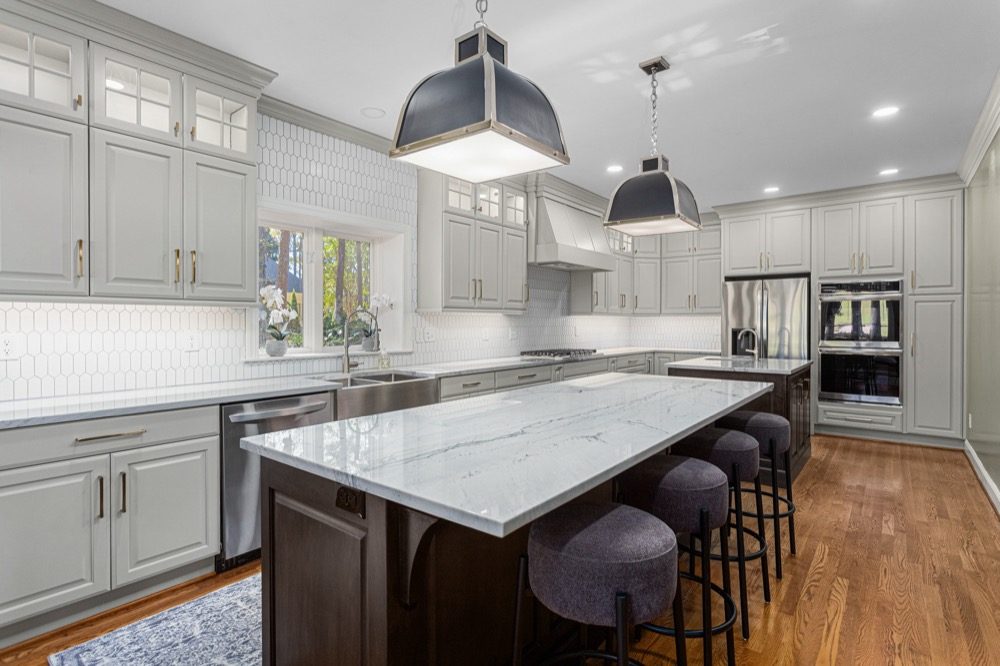
Large unsupported areas can experience stress when someone leans, sits, or places heavy objects on them. This is especially relevant for islands, breakfast bars, peninsula ends, and sections around sink or appliance cutouts.
Support may involve brackets, legs, corbels, or structural reinforcement designed into the cabinetry. The support system should be considered during planning rather than added after a slab begins to flex or crack.
Are visible seams always a fabrication mistake?
No. Seams are a normal part of many countertop installations.
A seam may be needed because of slab dimensions, room layout, access limitations, sink or cooktop openings, or the direction of the stone’s pattern. A well-made seam should be aligned, stable, and as unobtrusive as reasonably possible, but it may still be visible under certain lighting or when viewed from particular angles.
Highly patterned materials can make seam placement more noticeable. Uniform materials may make seams less apparent. The location and appearance of a seam should be evaluated before fabrication, especially on islands and long uninterrupted runs.
Does local weather affect stone countertops?
Seasonal conditions in Kernersville can influence how countertops are transported, stored, installed, and maintained, even though indoor surfaces are protected from direct weather.
Humidity, temperature changes, and heating or cooling cycles can affect cabinetry, adhesives, and installation conditions. A slab should be handled and supported properly during delivery and placed on cabinets that are level and structurally sound.
Indoor humidity can also contribute to moisture around sinks, dishwashers, and backsplashes. Wiping standing water and addressing leaks promptly helps protect both the stone and the cabinetry beneath it.
The most reliable expectation is that stone countertops are durable surfaces requiring reasonable care—not maintenance-free surfaces that can ignore heat, impact, moisture, or chemical exposure.